

Marilyn in her Office
Photo by Steve Aronson
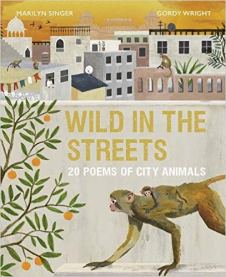
Today I am very happy to welcome award-winning author Marilyn Singer, who has written over 100 books for children and young adults. Marilyn joins us to celebrate her latest book, WILD IN THE STREETS: 20 POEMS OF CITY ANIMALS, illustrated by Gordy Wright and published by Words Pictures/Quarto.
An author in many genres (she says variety keeps her from getting bored), Marilyn lives in Brooklyn, NY with her husband Steve, a poodle, a cat, and two collared doves. She is no stranger to animals, and no stranger to wordplay! It is an absolute pleasure to host Marilyn here and to learn the story behind her latest poetry collection. Many thank yous to Marilyn for her time and also to Words Pictures/Quarto for offering a giveaway to a commenter on today's post.
Enjoy Marilyn's generous sharing of this backstory, and after you read, consider taking on her challenge to try a form of poetry she invented...the reverso!
Enjoy Marilyn's generous sharing of this backstory, and after you read, consider taking on her challenge to try a form of poetry she invented...the reverso!
In Brooklyn, New York, where I live,
there are more inhabitants than just people, dogs, and cats. On any given day,
I might see pigeons, sparrows, squirrels, a variety of insects and spiders, and
also the occasional rat. Those are the
animals people often hear about in the city. But in Brooklyn alone, there are
also red tailed hawks, peregrine falcons, monk parakeets, a variety of other
birds, raccoons, opossums, bats, and many other creatures. In fact, in cities
all over the world, you can find a wide variety of animals—and some of these
critters are quite surprising, from rhesus monkeys in New Delhi and wild boars
in Berlin to reticulated pythons swimming through sewers in Singapore and river
crabs living under ancient ruins in Rome.
Years ago, I got interested in city
animals and I wanted to write a prose book about ones found in America. An editor suggested that I go global. I’ve always liked research, but, at that
time, people did not own home computers—if you can imagine that—so it was difficult
to find articles and to contact people in different countries. And I certainly couldn’t afford to travel
around the world to see the animals in person.
Fast forward several decades: the
internet became available and research became a lot easier. I decided to revisit my idea. Only this time, instead of a prose nonfiction
book, I chose to write a book of poems, which would include some prose to
explain more about both the critters and the cities in which they lived. This time, the research was really enjoyable
and it revealed a number of surprises, such as those crabs in Rome and the wave
of huntsman spiders that enter homes to escape the rainy season in Cape Town,
South Africa. Furthermore, I thought it
would be a fun challenge to write the poems in a variety of forms, including
one I created: the reverso.
A reverso is one poem with two halves. The second half reverses the lines of the
first half, with changes only in punctuation and capitalization, and it has to
say something different from that first half.
I didn’t choose which animal went with which form in advance. I just went with the flow. Monarch butterflies seemed to want a reverso,
perhaps because they travel long distances to overwinter and so do tourists, so
a reverso is what they got. ;-)

©2019 Quarto Publishing, Used with Permission
(Click to Enlarge)
Monarch
Butterflies: Pacific Grove, California
After such a long and perilous journey
across wild mountains, tame gardens, familiar parks
and distant plains,
they leave behind
the trail of sweet-nectared flowers,
grateful for
their needed winter's rest in Butterfly Town,
hanging from the eucalyptus, still as dead leaves.
We tourists pause
to marvel at these precious pollinators
at last taking time off from work.
At last taking time off from work,
we tourists pause to marvel at these precious pollinators,
hanging from the eucalyptus, still as dead leaves
(their needed winter's rest in Butterfly Town),
grateful for
the trail of sweet-nectared flowers
they leave behind
across wild mountains, tame gardens, familiar parks, and
distant plains
after such a long and perilous journey.
The final result of this research and writing was WILD IN THE STREETS: 20 POEMS ABOUT CITY ANIMALS, published
by Words Pictures/Quarto and illustrated by the wonderful Gordy
Wright.
Oh — and I did get to visit those monarchs in
Pacific Grove, as well as the bats in Austin, Texas and, of course, the
peregrines in New York. I hope I get to
see some of these other creatures in their urban habitats someday. I hope you get to see some of them, too!
Some Questions and Ideas for You:
- Walk around your city or town. What animals do you see?
- What cities would you like to visit and what critters would you like to see there?
- Try writing a poem about a city critter you have seen or would like to see. Now try writing a prose piece. How do the pieces differ? Or do that in a team—one poet and one prose writer.
- What poetry forms do you like? Can you write a haiku about your critter? Can you write about it in another form?
- Try a reverso! It’s not easy, but it is fun!
Radio, Rhythm, and Rhyme
Today's Little Ditty
Jama's Alphabet Soup
Writing the World for Kids
Fuse 8
David Harrison's Blog
Today's Little Ditty
Jama's Alphabet Soup
Writing the World for Kids
Fuse 8
David Harrison's Blog
Thank you again to Words Pictures/Quarto for offering a copy of this book. If you would like to be entered into the giveaway, please just leave a comment by 11:59pm on Thursday, October 17, 2019.
Please share a comment below if you wish.

